
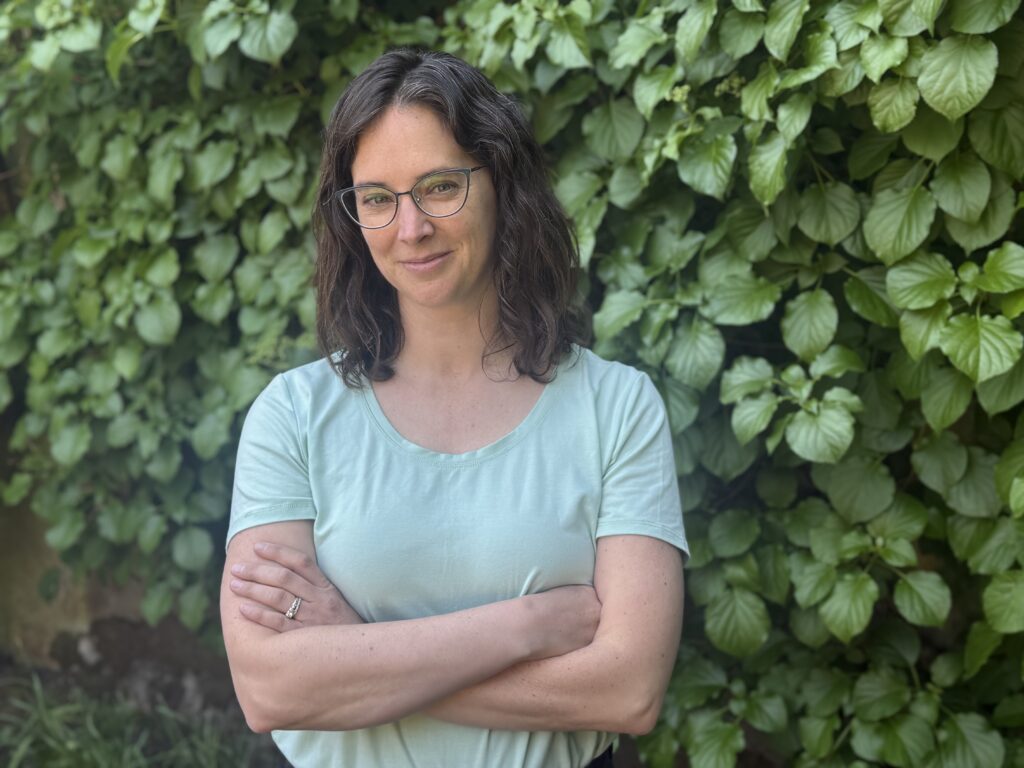
Emily Smejkal is on a mission to unveil what she calls Canada’s “invisible resource.” This month, the world arrives in Canada to see it.
Smejkal is a Cascade Institute researcher and an organizer of the World Geothermal Congress, which, from June 8 to 11, will host global experts and innovators seeking to accelerate the adoption of the clean energy resource.
Deep underneath Canada, in rock pressure-cooked by seismic forces, is a limitless supply of non-polluting energy just waiting to be accessed.
“It’s an invisible resource because it is hiding beneath our feet,” says Smejkal. “Most Canadians aren’t even aware we have it, let alone the important role it could play in unlocking abundant, clean energy to power our future.”
Unlike solar and wind power — which you can feel warming your face or messing up your hair — deep geothermal energy lies so far underground that its mere existence isn’t obvious. Its potential benefits, however, are widely understood by experts like Smejkal, who hopes the World Geothermal Congress will help turn the tide of public awareness.
As policy lead for the Cascade Institute’s Geothermal Energy Office and a research fellow on Cascade’s Ultradeep Geothermal team, Smejkal is one of the scientists working to pull geothermal energy out of obscurity and into production.
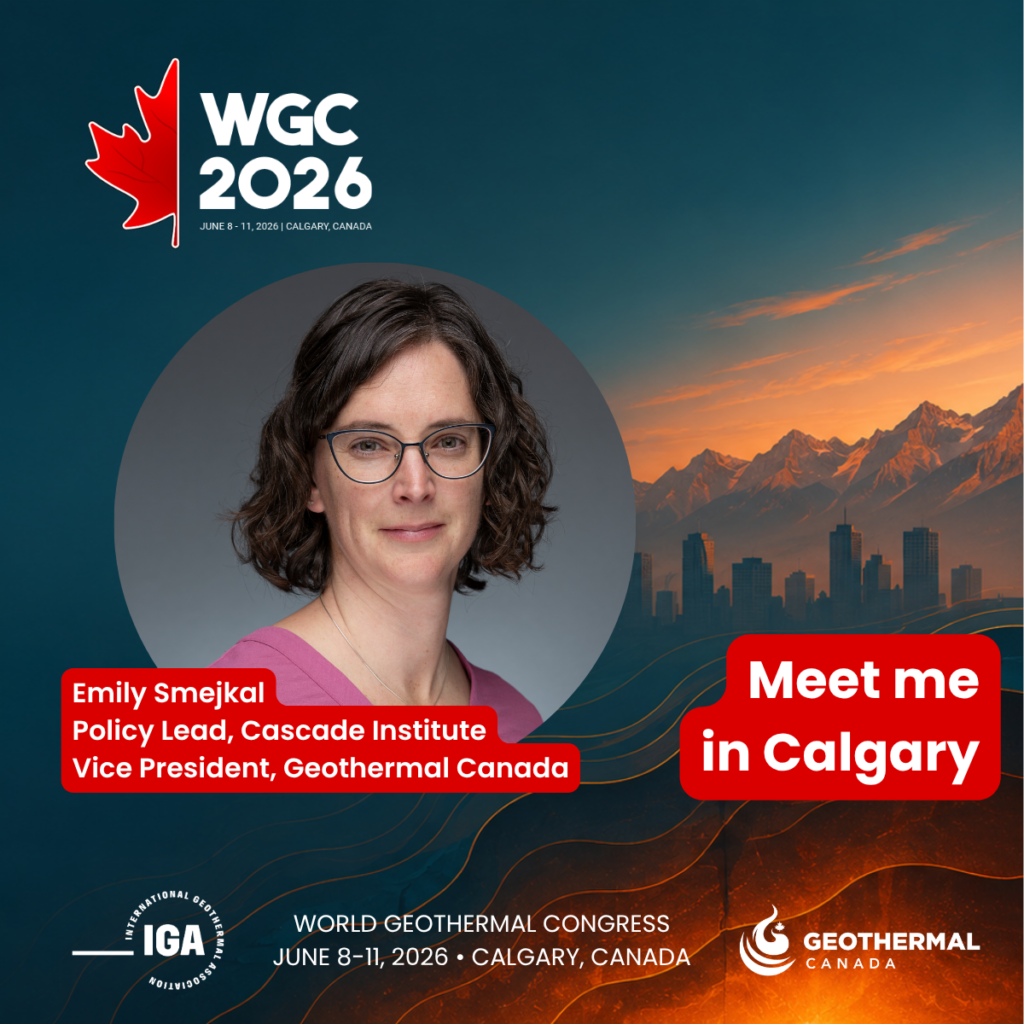
Smejkal has been instrumental in pulling together the 2026 World Geothermal Congress in Calgary. The triennial event is an opportunity to showcase Canada’s largely untapped geothermal potential on a global stage — and, she hopes, demonstrate to Canadian policymakers that geothermal should be an essential part of Canada’s clean energy transition.
The Cascade Institute views geothermal energy as a vital intervention for addressing and mitigating the polycrisis – the web of interconnected crises afflicting the world. Smejkal’s role involves demonstrating to policymakers, regulators, and the public that geothermal energy can power a better future.
Smejkal spent the first decade of her career as a geologist in Canada’s oil and gas industry, studying the hidden architecture of the Western Canadian Sedimentary Basin kilometres below the prairie.
“What’s below the Earth’s surface really fascinates me,” she says, “but I really wanted to lean into using those skills in a more environmentally sustainable way.” Geothermal was the natural fit.
Although geothermal energy requires complex science and technology to unlock, the basic idea behind it is stunningly simple.
“Geothermal energy literally just means earth heat,” she explains. “You bring the planet’s own warmth to the surface, run it through a turbine, and you get electricity that is renewable, carbon-free, and always on.”
For most of history, that heat was only accessible where it was right up at the surface of the Earth, at volcanoes and hot springs. This was great for places like Iceland, but not for places where heat is trapped much deeper, like most of North America.
Thankfully, Smejkal explains, Canada already has enormous drilling expertise from the oil industry, which translates almost perfectly to geothermal exploration.
 “Canadians are really good at drilling wells,” she says. Canada is the world’s sixth-largest oil and gas producer, and the International Energy Agency estimates that about 80 percent of oil-and-gas skills transfer directly to geothermal.
At a time when energy is quickly becoming the world’s most contested currency, Canada sits on vast geothermal reserves while remaining reliant on energy from elsewhere. Clean electricity accessible almost anywhere in Canada is about more than climate policy, Smekjal says — it’s about sovereignty too.
Unlike solar and wind, whose supply chains were long ago captured by China and the United States, geothermal is nascent and the supply chain is still largely up for grabs. The overlap with oil and gas also means that much of that supply chain already exists in Canada.
“If we don’t do it now, we’re going to be a technology taker instead of a technology maker,” says Smejkal.
Canada’s signature energy achievements of the past — the CANDU reactor, the oil sands, the unconventional gas boom — were no flukes. Each was a made-in-Canada technology driven by industrial strategy, public research, and implementing partnerships.
There’s a lot of work ahead. Only three provinces have geothermal regulations in place. Renewable tax credits, written for wind and solar, exclude the cost of drilling. The last federally funded national geothermal energy program ended in the 1980s.
So Smejkal does the essential work of drafting model regulations, speaking with policymakers, and coalition-building with like-minded scientists and entrepreneurs.
The World Geothermal Congress in June is the biggest opportunity Smejkal — and Canada’s entire geothermal coalition — has ever had to showcase the invisible resource that could revolutionize clean energy.
As vice-president of Geothermal Canada, the group hosting the conference, Smejkal has invited the world’s experts to a country that, historically, has underestimated the opportunity that lies beneath it. She believes this June in Calgary will mark a turning point for her field, especially in Canada.
“My ultimate goal,” she says, “is for Canada to be a geothermal leader. We have the resources and skill — we just need the collective will.”
