
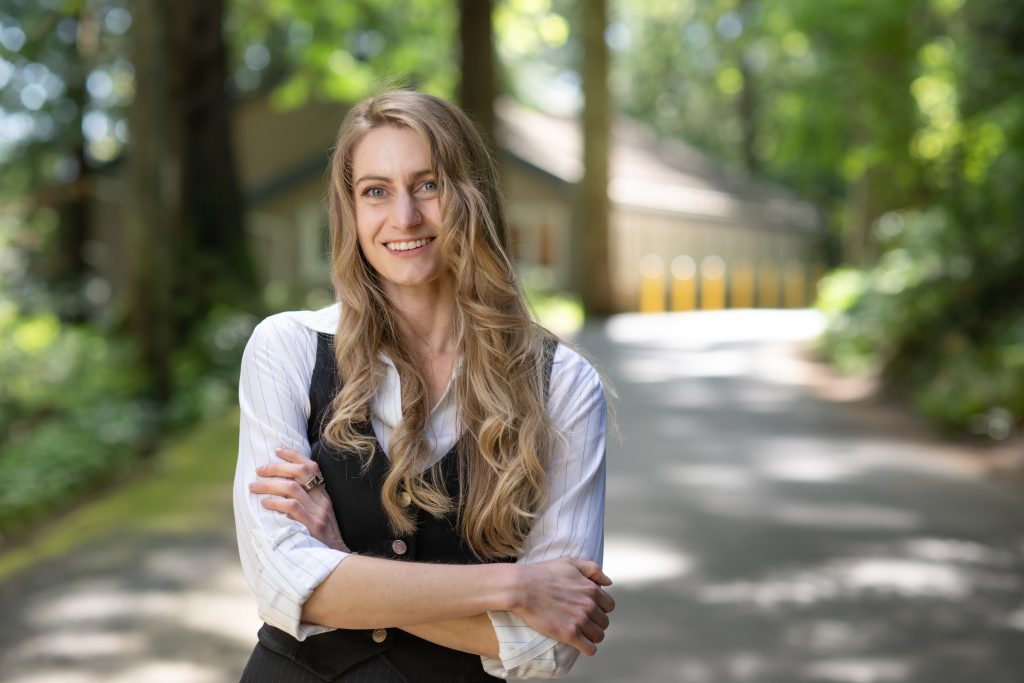
Rebecca Pearce is building a model of something nobody can see: the intense heat trapped kilometres beneath Canada. It’s also a model of a better future for all.
Pearce is a geophysicist and the science lead for the Cascade Institute’s Ultradeep Geothermal program. She studies a resource tucked so deeply out of sight that most people don’t realize it’s there. Pearce is modelling an inexhaustible zero-carbon resource that could power Canada’s prosperity for generations.
“Geothermal energy is our next energy revolution,” she says. She and her Cascade Institute colleagues have conducted research and published reports demonstrating that existing Canadian technology and expertise (inherited from the oil and gas industry) can quickly spark big advances in geothermal.
The Cascade Institute studies the polycrisis: the tangled web of compounding climate, energy, economic and geopolitical crises we’re living through. The Institute identifies high-leverage interventions (well-timed nudges that can ripple outward to address numerous problems at once) and works with governments and frontline actors to act on them. Geothermal energy is among the most promising of those interventions.
Just as multiple crises can interact and snowball in pernicious cascades, so too can the right intervention at the right time spark a virtuous cascade of improvement toward a better future.
Research shows that geothermal energy can significantly ease some of the pressures straining the global energy system while accelerating the shift to clean energy sources in response to climate change.
Pearce aims to translate the complex geophysics of geothermal into language that resonates with the policymakers and communities who stand to benefit from it. To that end, she delivered an impassioned TEDx Talk at Royal Roads University in 2025:
“Beneath us lies an infinite supply of heat,” she says in the talk. Energy from just the top 10 kilometres of crust, she explains, “could supply our current global energy needs for over 200 million years.”
 Pearce has chased underground heat round the planet since pursuing her PhD at University College London. She is an expert in applied magnetotellurics (think X-rays for the ground, which allow scientists to locate geothermal hotspots deep below the surface).
“Geothermal can truly be found anywhere,” says Pearce, who lives in Victoria, BC.
Her fascination with the underground began early, during childhood hours spent gazing at the Royal Ontario Museum’s volcano exhibit. She was fascinated by the hidden forces that shoved continents together and pushed up mountains.
Although the geophysics Pearce pursues is complex, the basic principles behind geothermal energy are simple: heat from underground makes steam, which spins a turbine to make electricity. It’s similar in that regard to oil and gas, with a key differentiator—geothermal doesn’t burn anything, so there are no emissions. The power is constant and clean.
The heat beneath Canada, and much of the world, has been largely inaccessible until recent advances have made geothermal both widely achievable and affordable.
But there’s a problem: large swaths of Canada’s underground remain unmodelled. Without a model, there’s no government support, no drilling, no progress.
The goal, Pearce says, is for the model to be “akin to a wind or solar map, so we can illustrate to policymakers that geothermal resources exist across Canada.”
Pearce and her Cascade Institute colleagues will be part of the World Geothermal Congress, which is being held this June in Calgary. Hosting the event on Canadian soil is a rare opportunity to showcase the incredible potential for geothermal energy in the country.
Pearce points out that in 2023, the world invested $2 billion in geothermal technology; wind power, by comparison, received $200 billion That kind of money could have funded 400 full-scale geothermal demonstration projects, Pearce says, “but we currently have four.”
“Geothermal isn’t failing us,” she told her TEDx audience. “We are failing geothermal.”
Pearce is convinced this can change, and that Canada is unusually well-placed to change it. The country’s decades of oil and gas drilling expertise transfer almost directly to geothermal. She hopes to change that, and believes geothermal energy is on the cusp of a boom for those who seize the opportunity.
“It will sustain us for thousands of generations to come,” she says. “That is our return on investment.”
