
Cross-Impact Balance Analysis (CIB)
Cross-Impact Balance Analysis (Weimer-Jehle, 2006) is a mathematically rigorous method for identifying possible stable futures in systems that involve many interdependent variables. Analysts first identify all the candidate systems’ key state variables (called “descriptors”) and the different quantitative or qualitative “states” those variables may take. They then quantify in a matrix the degree to which each variable state promotes or inhibits every other variable state. These judgements about impact can be derived from various sources, including literature reviews, expert consultations, and experienced estimation.
In CIB language, each global system in our Polycrisis Core Model constitutes a descriptor, and each possible future configuration of this global system constitutes a distinct state of the descriptor.
For example, our global governance descriptor includes the states: minimal engagement, bloc consolidation, multilateral cooperation, and thick global governance.
The method creates a matrix with all the descriptors (systems) and their states (possible configurations) arranged as both its rows and its columns. In each cell of this grid, we estimate (using a Likert scale) the extent to which a particular state of one system promotes, inhibits, or has no effect on each possible state of all other descriptors.
The CIB software ScenarioWizard then tests every possible combination of descriptor states to find those combinations that are mutually supportive, and thereby constitute an inter-systemic equilibrium.
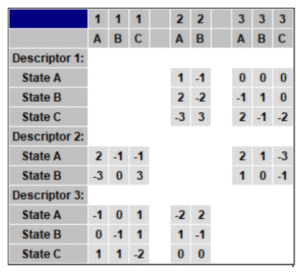
Below, for illustration, is a generic example of a CIB matrix with three descriptors, each with 2-3 possible states. Given the influence judgements (numbers) we’ve arbitrarily entered in the cells of the matrix, the combination of states 1C, 2B, and 3A emerges as a stable, mutually reinforcing equilibrium. (To understand how, please see the seminal introduction to the method by Wolfgang Weimar-Jehle attached to this email).
Our polycrisis core model involves ten descriptors (see decahedron diagram above), each with 3-5 states. The CIB method will evaluate every inter-systemic relationship (i.e., line in the decahedron).
