By Peter Massie (Cascade Institute), Gordon Brasnett (Cascade Institute), and Jotham Peters (Navius Research)
Presented at the EMH Annual Forum 2025
Quick Links
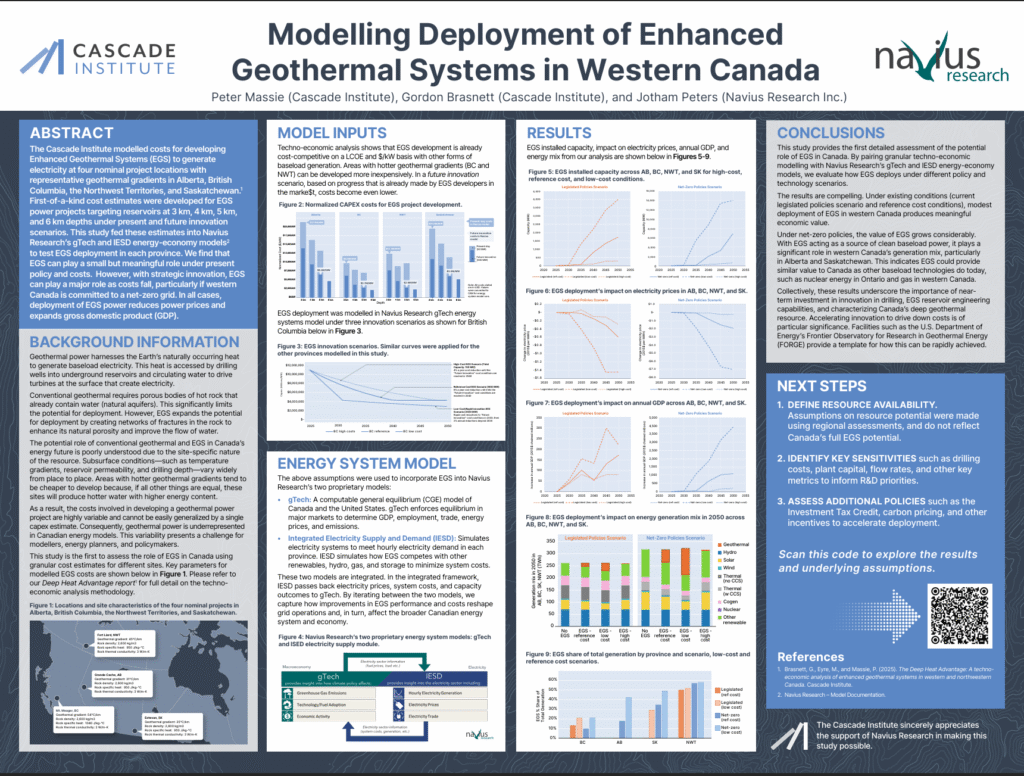
- View the poster
- Explore the results in Tableau
- Read the technical report The Deep Heat Advantage: A techno-economic analysis of enhanced geothermal systems in western and northwestern Canada
Abstract
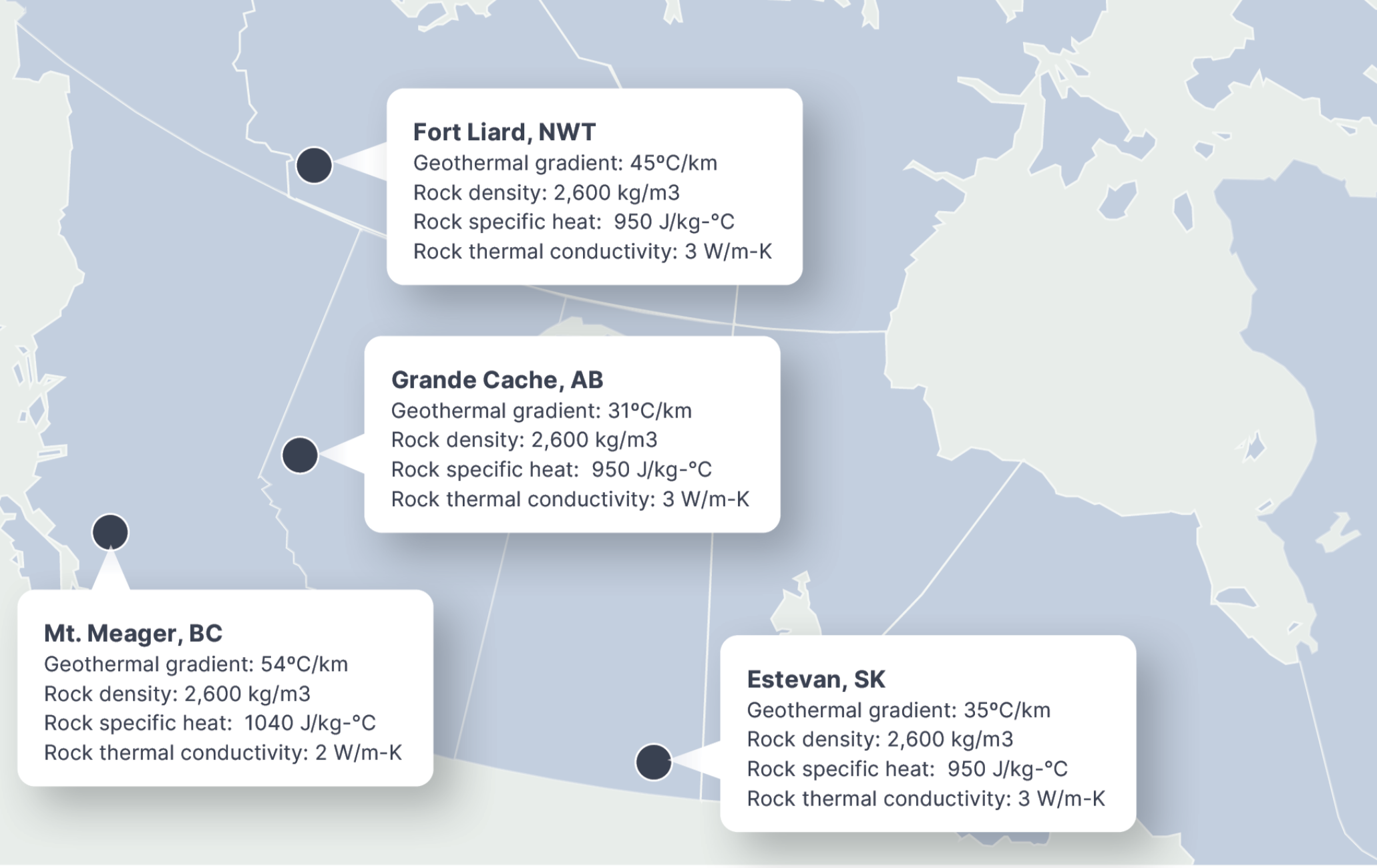
The Cascade Institute modelled costs for developing Enhanced Geothermal Systems (EGS) to generate electricity at four nominal project locations with representative geothermal gradients in Alberta, British Columbia, the Northwest Territories, and Saskatchewan.
First-of-a-kind cost estimates were developed for EGS power projects targeting reservoirs at 3 km, 4 km, 5 km, and 6 km depths under present and future innovation scenarios.
This study fed these estimates into Navius Research’s gTech and IESD energy-economy models to test EGS deployment in each province.
We find that EGS can play a small but meaningful role under present policy and costs. However, with strategic innovation, EGS can play a major role as costs fall, particularly if western Canada is committed to a net-zero grid.
In all cases, deployment of EGS power reduces power prices and expands gross domestic product (GDP).
Background
Geothermal power uses underground heat to generate firm, baseload electricity. Wells are drilled into hot rock, water is pumped to the surface where it drives a turbine, then it is re-injected underground so the cycle can continue.
Conventional geothermal requires naturally porous, water-filled reservoirs. EGS expands the resource base by creating engineered fracture networks that improve fluid flow in otherwise impermeable rock.
Canada’s geothermal potential varies widely by location. Temperature gradients, reservoir depth, and subsurface conditions strongly affect cost. Hotter gradients — such as in parts of BC and the NWT — lower development costs because higher temperatures increase energy output.
Because costs are highly site-specific, geothermal is often underrepresented in energy models. This study incorporates granular cost inputs by depth and geography, allowing a realistic assessment of EGS in western Canada.
Model Inputs
Techno-economic analysis shows EGS is already competitive with other forms of firm generation on both LCOE and capital cost metrics; this is especially true in regions with hotter geothermal gradients. In an innovation scenario reflecting reasonable advances and cost efficiencies in key project aspects such as drilling and reservoir engineering costs decline further.
EGS deployment was modelled across western provinces under three innovation scenarios:
- A high-cost, slow innovation, low available capacity EGS scenario;
- A reference cost, moderate innovation, mid available capacity EGS scenario; and
- A low cost, rapid innovation, large available capacity EGS scenario.
The modelled cost curves for each province are shown on the data visualization below. Mouse over the cost curves to see additional information, or select a different province in the upper right corner of the visualization.

Deployment for each EGS cost curve was modelled using Navius Research’s gTech and IESD energy-economy model under legislated policies and net-zero pathways. Results show EGS contributes differently depending on cost assumptions and policy ambition, with weakest EGS deployment in high-cost conditions and legislated policies, and greatest EGS deployment in a low cost, rapid innovation scenario where net-zero policies are adopted.
Due to its role supplying baseload electricity, EGS complements renewables and reduces reliance on natural gas, particularly in a net-zero policies scenario.
Installed Capacity
EGS adds firm capacity that stabilizes and reduces the requirement to overbuild electrical grids with generation sources that have low capacity factors. In fact, a rapid EGS innovation scenario where western Canada commits to net zero policies, EGS was modelled to reduce the total required installed grid capacity from approximately 125,000 MW to 95,000 MW. This has a meaningful impact on modelled electricity prices.

Electricity Price Impact
Across scenarios, EGS lowers long-run electricity prices by reducing fuel costs and improving system efficiency.

GDP Impact
EGS deployment increases GDP by stimulating investment, lowering power costs, and expanding economic activity.

Conclusion
Enhanced Geothermal Systems can contribute meaningfully to western Canada’s electricity future. Under current legislated policies and cost conditions, deployment is modest. However, with investments in innovation that further improve EGS economics, EGS becomes a significant source of firm, low-carbon power – especially in a net-zero electrical grid. Across all scenarios, EGS deployment reduced electricity prices and grew GDP.
Connect with Cascade's Deep Geothermal Team
Cascade's Deep Geothermal Program aims to unlock Canada's vast geothermal potential.
Contact Peter Massie:
Director, Geothermal Energy Office (CI-GEO)
Cascade Institute, Royal Roads University
E-mail: massie@cascadeinstitute.org
Related Research & Analysis
Geothermal Innovation, Intellectual Property, and the Prospects for Canada
Deep Geothermal program
James W. Hinton, Peter Massie, Rachel Wang
An exploration of the IP landscape surrounding geothermal energy.
Deep Listening: Assessing the social acceptance of geothermal energy
Deep Geothermal program
Katherine Matos Meza and Carlos Gorraez Meraz
The first empirical assessment of public perceptions and social acceptance of ultradeep geothermal energy in Alberta and British Columbia.
Geothermal Exploration, Data Sovereignty, and Indigenous Power
Deep Geothermal program
Leighton Gall and Cyndi Bonn
A handbook for empowering Indigenous Peoples to lead the renewable energy transformation while advancing Indigenous sovereignty.
Geothermal Potential in Baker Lake, Nunavut
Deep Geothermal program
Ysaline Bacon
Research to support enhanced geothermal systems in Northern remote communities
The Deep Heat Advantage
Deep Geothermal program
Gordon Brasnett, Megan Eyre, and Peter Massie
A techno-economic analysis of enhanced geothermal systems in western and northwestern Canada
Groundwork: Regulatory guidelines for making Canada a geothermal powerhouse
Deep Geothermal program
Emily Smejkal, Princess Sharlynne Cosalan, Stephanie Rose Cortinovis
A report identifying best practices to help Canadian provinces establish effective geothermal regulations and make Canada a global clean energy leader.
AOSTRA: A model for funding geothermal innovation
Deep Geothermal program
Emily Smejkal, Peter Massie, Leighton Gall
A case study of the Alberta Oil Sands Technology and Research Authority (AOSTRA) as a model for kickstarting geothermal innovation.
Prospecting for Superhot Rock Energy
Deep Geothermal program
Rebecca Pearce et al.
A technology gap analysis for siting and characterizing superhot rock energy resources.
Drilling for Superhot Geothermal Energy: A technology gap analysis
Deep Geothermal program
Rebecca Pearce, Tony Pink
A report that reviews state-of-the-art deep geothermal drilling and well-construction technologies, identifies existing technology gaps, and suggests strategies to overcome these gaps.
Ultradeep Geothermal Research and Action Roadmap
Deep Geothermal program
Leighton Gall, Dave Lovekin, Rebecca Pearce, Emily Smejkal
A roadmap outlining a plan to advance ultradeep geothermal power to commercial operation in Canada.Related News & Views

Webinar: Beneath the surface — Social acceptance of geothermal systems in Western Canada

Working groups begin drafting Deep Geothermal Roadmap

Canada has an energy conundrum in the North: geothermal energy is the answer
Peter Massie and Jax Jacobsen
The Hill Times
Whitehorse sits atop a promising geothermal resource. Developing it would strengthen Canada’s national security and relations with Arctic allies.
NRCan’s call for test centre proposals a big opportunity for energy innovation

Canada invests in first national geothermal energy roadmap; Cascade Institute to lead coalition