
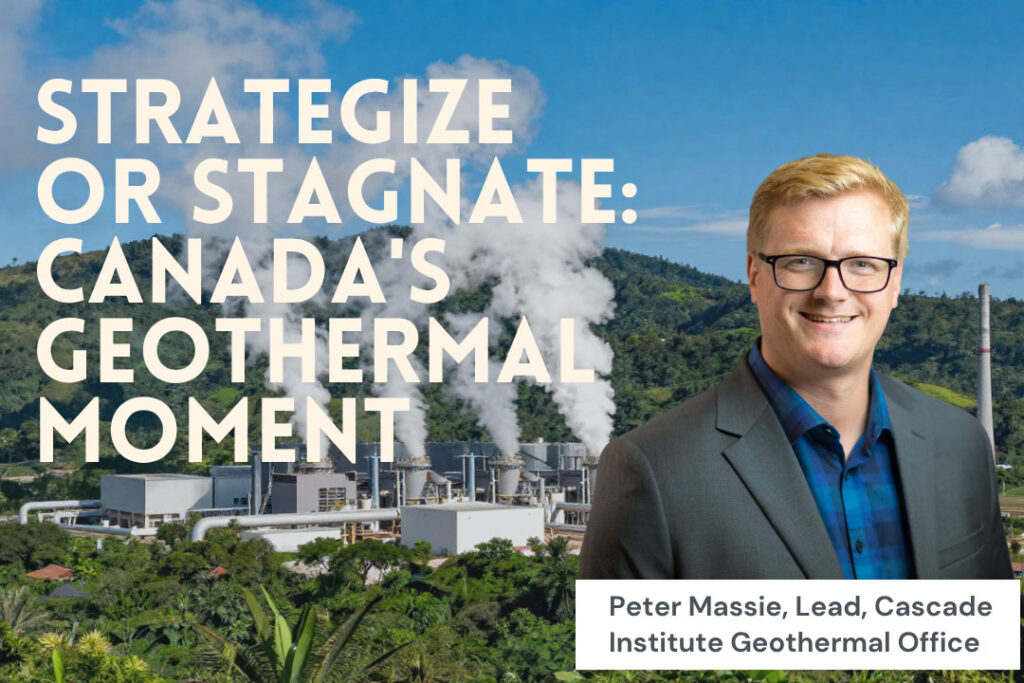
Peter Massie spent a decade inside Canada’s energy bureaucracy, where he learned the importance of strategic industry policy.
That makes Massie ideally positioned to make the case that Canada needs to rebuild its energy strategy to seize the rare opportunity presented by geothermal energy.
Canada sits atop an enormous, inexhaustible supply of clean geothermal energy, but the country currently lacks a cohesive strategy to unlock that energy for the benefit of Canadians.
Massie runs the Cascade Institute’s Geothermal Energy Office from Ottawa, guided by a foundational idea: Canada’s greatest energy achievements were not accidents — they were strategized. For example, Canada’s oil and gas industry it is the result of smart, targeted research and development.
“Maintaining a strong energy sector is no longer just an economic imperative for Canada,” he argues. “It’s an existential one.”
Energy, Massie says, is quickly becoming the most sought-after global currency. Canada holds the fourth-largest oil reserves on the planet — and sells almost all of it to a single, increasingly unpredictable customer south of the border.
“Expanding our infrastructure is already showing returns, but it’s a comfortable half-measure,” he says. “And comfort is no longer a viable strategy.”
The energy is there, but tapping it requires smart cooperation across government, academia and industry. It requires (sometimes risky) business of a country investing in something new. Massie likes to borrow a line from the Harvard economist Michael Porter: “National prosperity is created, not inherited.”
“Canada’s natural resources were our inheritance,” Massie says. “The technologies that convert them to prosperity are creations of Canadian ingenuity.”
Massie sees geothermal as an essential companion to Canada’s other energy industries – each of which emerged from deliberate strategy. The CANDU reactor grew out of the Chalk River laboratories and a postwar federal push. Steam-assisted gravity drainage, the made-in-Canada breakthrough that unlocked the deep oil sands, came from a 1970s coalition of government, industry, and academia.

“These projects were defined by strategic long-term thinking, calculated risk-taking, and collaboration across the public and private sectors,” Massie says. In recent years, he argues, Canada has drifted into “a non-strategy — much talk, but little clarity over what, exactly, we need to do as a nation to remain competitive.”
Massie believes Canada should start with what it’s best at; the country’s deep subsurface expertise — built over decades of oil and gas production — transfers almost directly to new industries like geothermal energy, critical minerals, and carbon capture. Canada is perfectly positioned to be a goethermal leader.
But Massie is also adamant that technology is never enough on its own. “Technology does not exist in a vacuum,” he says. “Technologies exist in social and economic systems. And when we want to drive a transition, we have to drive a socio-technical transition.”
That requires the unglamorous work of dissecting regulations, markets, institutions, and public opinion. “There is no such thing as technology neutrality,” he says. “Blunt instruments, such as the carbon price and tax credits, can scale existing industries. But alone, they just aren’t enough for transformative breakthroughs.”
For the Cascade Institute — which studies the tangle of interconnected global crises called the polycrisis — geothermal is what’s known as a high-leverage intervention. Geothermal can be a well-timed “nudge” that alleviates strains on multiple global systems at once.
“By providing a source of clean baseload power, geothermal can relieve all kinds of other systemic stressors, including energy security, powering data centres, and addressing climate change” says Massie.
Massie spent more than a decade in the federal government, most recently as acting director of strategic policy and techno-economic analysis in Natural Resources Canada’s Office of Energy R&D, modelling how emerging technologies could help Canada decarbonize.
Nowadays, the stakes are far greater to Massie. He’s a new father, so the future he studies and strategizes for is also the one his daughter will inherit.
“Canada has faced challenging moments before,” he says. “Each time, we made the choice to invest, innovate, and lean into our strengths. With higher stakes than ever, we now face that choice again: strategize or stagnate.”
