
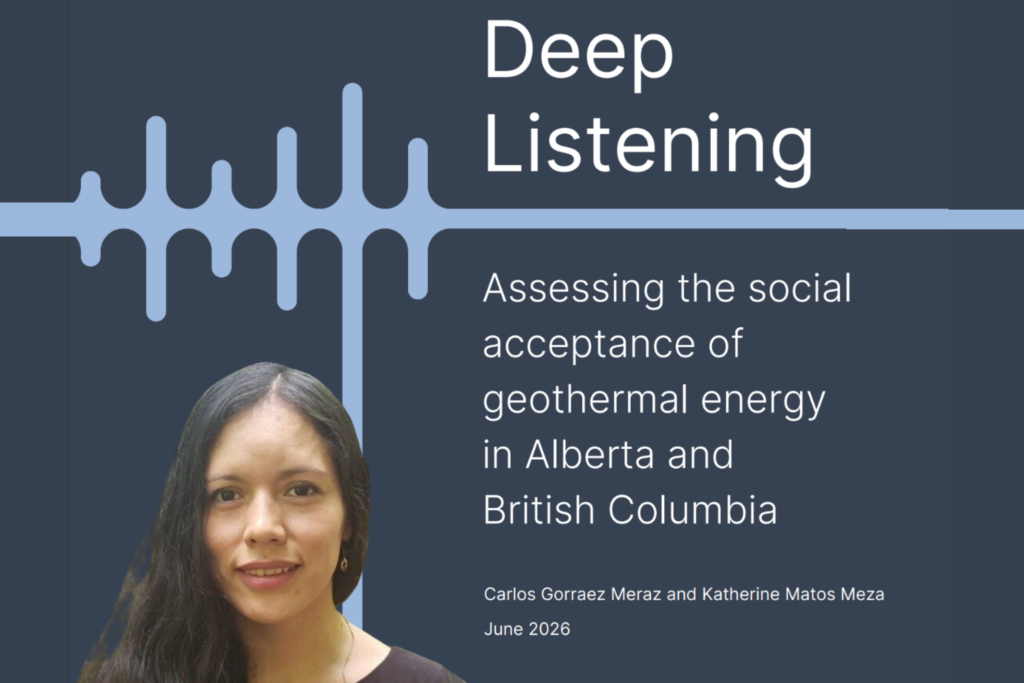
On Oct. 21, Cascade Institute researcher Katherine Matos Meza and Carlos Gorraez Meraz presented the findings of their report Deep Listening: Assessing the social acceptance of geothermal energy during a webinar and roundtable discussion hosted by ACET (Accelerating Community Energy Transformation). ACET Executive Director Curran Crawford moderated, Matos Meza and Gorraez Meraz presented their work, and a panel of experts discussed the findings: Cascade Institute’s Geothermal Policy Lead Emily Smejkal; Dr. Amel Barich, founder and CEO of Geoscience Research and Communications; and Clean Air Task Force Super Hot Rock Geothermal Policy Manager Ann Garth.
We caught up with report author Katherine Matos Meza after the event to discuss her findings.
Q: This was the first study of geothermal’s social acceptance in Alberta and British Columbia. What did you find?
KMM: The main result was that the audience is unfamiliar with geothermal energy, but despite the low level of familiarity, the general social acceptance of geothermal is moderate, and there’s no tangible opposition.
It was interesting to see how these findings are similar across Alberta and British Columbia, as we were expecting to find a different level of progressiveness in these two provinces.
Basically, that makes us think that we are really in a good moment to start informing people about geothermal and building the social acceptance. It’s important to help the general audience understand how geothermal works, and its potential for their communities, especially in Canada where we have cold winters. We are already seeing an increase in energy demand, and we need reliable sources of clean energy, especially in winter.
Op-ed
Drilling down: How Canadians feel about geothermal energy
Katherine Matos Meza and Simone Philpot unpack the Deep Listening findings in Canada’s National Observer.
Q: You polled people in British Columbia and in Alberta – which province was more supportive of geothermal?
KMM: Talking about numbers, on a scale from 1 to 5, Alberta’s social acceptance level was 3.07, and British Columbia’s was 2.97. So, they were close. I would say that acceptance is moderate in both provinces. We didn’t find any substantial differences between them.
Q: How would you define “moderate”?
KMM: A moderate level of social acceptance suggests that attitudes toward geothermal energy are generally neutral to mildly positive, indicating that people do not yet hold strongly positive or strongly negative views. This leaves room for perceptions to evolve as familiarity increases.
Perceptions around technologies can change really fast. When familiarity with technology is low, but acceptance is moderate, there is a significant opportunity to build social acceptance, as people have not yet developed strong positive or negative views about it.
There’s no hardened opposition to geothermal in these provinces. In some industries, we can already see opposition, especially in oil and gas. In the U.S., there are some spillovers from oil and gas opposition that are going to affect geothermal, but we don’t see that here in Canada. Maybe that’s because Albertans feel comfortable with drilling, because they are an oil and gas producer. They understand what drilling is, and how it has impacts, but also that it can be well managed.
It’s important to start building trust in geothermal before other actors come into the picture. But we need to do this in a transparent and technical way. A lack of accurate information from a project can contribute to negative public perceptions and undermine social acceptance. In this study, we examined the level of trust in a range of organizations and groups. Utility companies, oil and gas companies, and mainstream media were among the least trusted sources. Scientists and universities, on the other hand, were the most trusted messengers, which suggests that people want accurate, evidence-based information.
Q: Who else are seen as trusted messengers on geothermal?
KMM: The most trusted messengers are scientists and universities, but also environmental NGOs and renewable energy companies. This data suggests that people want technical information. This is interesting, because that means that people are open to listening to renewable energy companies, and geothermal is within the renewable domain. That’s our top tier of trusted messengers. The government—municipal, provincial and federal—are in the middle of the list. Among the least-trusted were oil and gas companies, and mainstream media.
Q: According to the survey, support for geothermal is strong compared to other energy options. What does that mean?
KMM: We asked people to what extent they support geothermal compared to other energy options. It was a direct question comparing geothermal across different energy sources currently available in British Columbia and Alberta. The results show that geothermal has positive signs of support. We didn’t find that there’s any tangible opposition to geothermal compared to other energy options, particularly renewable energies—this further reinforces that there is moderate acceptance of geothermal from people who are unfamiliar with the industry.
Q: Acceptance of geothermal energy was higher among men than women, according to the study. Why is that?
KMM: On average, research shows women tend to be a bit more cautious, and men tend to perceive lower risk and be more willing to take risks. So, these results might be a reflection of that. It may also reflect women’s lower involvement in the energy sector.
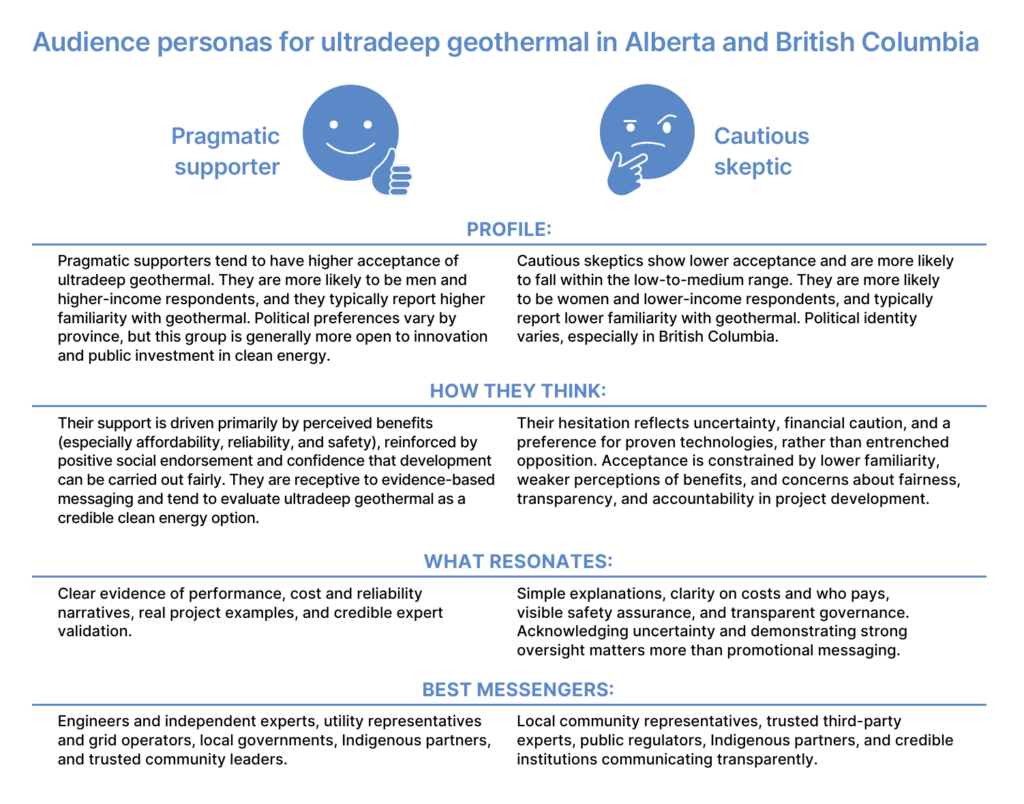
That’s also the reason why the communication strategy could be tailored according to the different demographic profiles. In the report, we present two audience personas that illustrate that and how the report results can be translated into engagement approaches.
Q: You mention a “window of opportunity” for geothermal energy, and you point out that there are things that could close that window of opportunity. What specific factors could lower support for geothermal development?
KMM: A lot of things can change people’s perceptions around geothermal projects. When topics become politicized, you can see misinformation start spreading. There are a lot of factors that can ignite opposition, not only a bad project or a misleading company giving bad information. It’s hard to anticipate where this might come from, how it could evolve, or how fast this can happen.
This is where our window of opportunity matters: if we have informed the public about the benefits of geothermal, we make it a little harder for misinformation to spread. We can work to build positive perceptions of the industry with technical information. It’s really important to build social trust, build social acceptance, while also looking at how these conversations will evolve across Canada and in the U.S., because what happens there tends to overlap in Canada.
Q: What should geothermal energy advocates learn from your work?
KMM: The study asks what people care about when they think about energy sources, and the results are telling us that people want affordable energy, they want reliable energy, and they want safe energy. Those were the top priorities. If geothermal can provide those benefits, we need to lead with what people value the most and show how geothermal can bring these benefits to their communities.
Read the full report: Deep Listening: Assessing the social acceptance of geothermal energy
